Disclaimer: This is a personal weblog, reflecting my personal views and not the views of anyone or any organization, which I may be affiliated to. All information provided here, including recommendations (if any), should be treated for informational purposes only. The author should not be held liable for any informational errors, incompleteness, or delays, or for any actions taken in reliance on information contained herein.

Personal sharing of Global financial investment

Some of the valuable information:

1. Ways to prosper from the Global financial market

2. Global financial market review & information

3. Global stock market analysis

4. Understanding the importance of Global financial system towards us


Search This Blog

Followers

Monday, November 29, 2010

KLCI may fall into longer correction after forming Top Reversal Pattern - 29/11/10

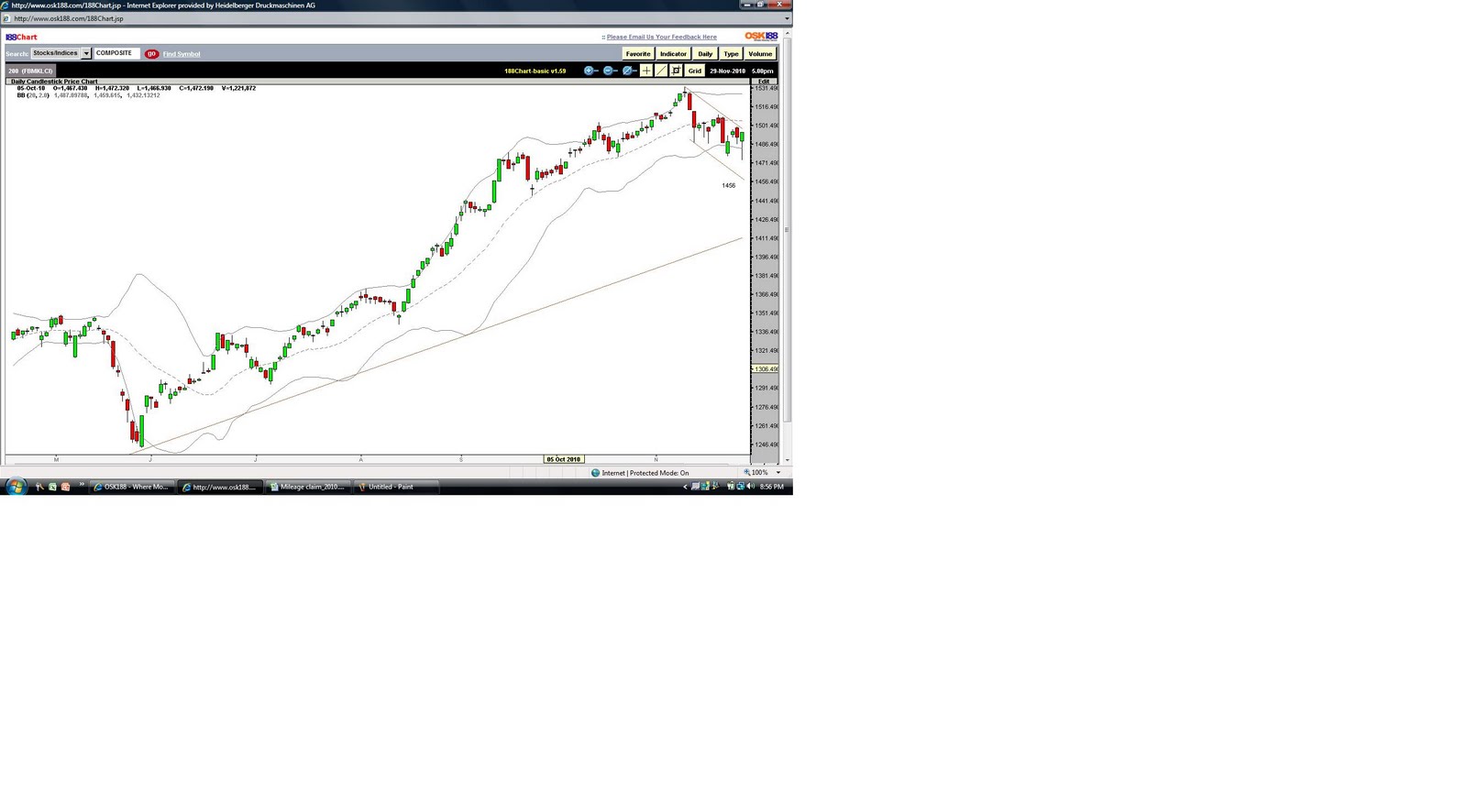
Chart: KLCI daily chart1 (Source: tradeSignum)

Refer to KLCI daily chart shown above, the KLCI hit the new high of 1530 and retreated to the low of 1474 level on 29th Nov 2010. Further to this, the KLCI is forming a Top at 1530 and reverse into short term downtrend pattern. It has tried several rebound but has yet broke the previous high, subsequent to the failures, the KLCI may continue the correction until a stronger support is builded.

Resistance levels
1500, 1505, 1530

Supports level
1480, 1465, 1456

Near term outlook
Bearish - Short term downtrend, heading towards 1480 level.

Long term outlook
Bullish - Long term uptrend, as long as the index stay above the main uptrend support line.

Trading opportunity
Cautiously pick up some good fundamental stocks during profit taking.

Favourite stocks recommendations
Finance - Maybank, CIMB, RHBCAP, PBB.
Consumer - CI Holdings, TWS. (TWS has broken the main resistance, outlook strong buy)
Construction - Sunway, Gamuda.
Healthcare - KPJ, Faber.
Plantation - BStead, TDM, MHC, Cepat.
Trading/services - Kfima.
Gaming - Genting.
Telecommunication: Axiata.

Sunday, November 28, 2010

不拼輸贏 享受情趣; 胡立陽 抱著玩尋寶心情買股票

投資股市應該像巴西人跳桑巴舞一樣,帶著愉快的心情,但卻很有規律的。

要不然,就把股票投資當是一種尋寶遊戲,不拼輸贏,自然而然你就會覺得股市是一個遊樂場,並不是所謂的“會吃人”的市場或賭場。

被譽為台灣“股市教父”的胡立陽說:“只要別把賺錢當為投資股市的第一目的,你才能真正享受投資股市過程中所帶來的快樂。”可能你會問:不為錢那投資股市做啥?

他笑說:“投資股市就應該只為增加生活情趣,如果賠錢很傷心,賺錢更痛苦的人,根本不適合買股票。”

胡立陽:不把賺錢作為投資股市的第一目的,才能真正享受投資的快樂。在胡立陽眼中,大馬就像10至20年前的台灣,大部分投資者都對投資存有不正確觀念,但只要將正確觀念嵌入每個投資者心里,再配合推廣投資教育,大馬股市自然就會蓬勃發展,也慢慢會活潑起來。

“別將投資股票當作一門職業來經營,應當作是尋寶遊戲一樣,如果只為了賺錢,抱著股票就像抱著憂愁,每日提心吊膽,那就一點都不快樂。”

他說,20多年前被邀回流台灣時,當時台灣並不流行投資股票,投資氛圍也較為嚴肅,股市規模也非常小,大家都當股市是“會吃人”的市場,就有少碰為妙的心態。

當時,他透過幽默風趣的演講及教育,將投資股市愉快的氣氛感染大家,並糾正投資觀念。
短短3年時間,他帶動投資股市的風氣。

到過世界各地演講,幾乎舉凡有華人的地方都遍佈他的足跡,胡立陽發現,人性沒有改變,不一樣的只是活潑及嚴肅的分別。

開始關心時事行情

他說:“只要放寬心,只要把賺錢放在其位,旨在享受投資過程帶來的樂趣,輕鬆看待股票投資,股市變得活潑了,參與的人自然就活絡起來,屆時大家自然都能從中賺到錢。”

“你會發現買了股票,生活將不再那么乏味,你會開始看很多書、報章雜誌、開始關心油價、金價、利率,生活變得多彩多姿起來。”

研究說,巴西股市是全球最送錢的股市,那是因為當地投資者就像跳桑巴舞一樣,很有韻律,買了股票就像買了一個無窮的希望,不但覺得好玩又賺錢。

“第二送錢股市就是新加坡股市,那里的投資者都很規矩很守法,該買時買該賣時賣,股市的圖形呈獻很有規則,就像典型的教科書,可以說所有華爾街理論都可運用于新加坡股市。”

“只要跟著規則走,就很容易賺到錢,所以大家要珍惜這樣的股市;大馬股市投資者參與度只要再提高些,再活潑輕快些,自然會像新加坡、巴西或華爾街股市一樣,更活絡更繁榮。

1. 馴服熱錢 變長期留駐資金

幽默風趣的胡立陽,曾創下連續3年平均每年超過1000場的演講記錄。“成也熱錢,敗也熱錢!”這只在一線之間,胡立陽說熱錢並不可怕,反之是千載難逢的機會,一旦成功馴服熱錢這壞孩子,熱錢就有可能變成長期留駐的資金,在國家建設上助上一臂之力。

美國近期實施的貨幣量化寬鬆政策(QE2)瘋狂印鈔,導致亞洲各國人心惶惶,深怕大量熱錢聚焦亞洲會引發泡沫,進而爆發另一輪金融危機。

國際貨幣基金組織總裁史特勞斯卡恩更建議,應在必要時實行資本管制,以阻止另一輪金融危機降臨。

胡立陽認為,各國政府無需恐慌,只要夠膽識及懂得善用,就可將頑皮的孩子變成乖寶寶,海水也可變淡水,真正把投機資金變成投資資金。

他建議說,我們可以設立一個基金或債券,或是混合型的各式建設基金,然后由政府背后支撐,或跟銀行合作給個較市面定存年利率高上2%至3%的適度保證回酬,吸引這些資金一起搞建設。
因為很多政府都有龐大外匯存底,以這做背后支撐,政府只要冒個非常低風險,給這些資金信心,給予高出一般市面上的年回酬,這些資金自然就留下來了。

“畢竟全世界都需要基礎建設,如果資金是來炒作,我們不要,如果是來參與建設,何樂而不為?也能順勢帶動經濟成長。

“我們越想鎖住或禁止熱錢進出,又無某程度上的保證,沒有信心,這些資金當然夾帶逃,真正變成到處竄逃的熱錢,屆時當然世界大亂。

“越是規矩多多綁手綁腳,它就會越掙扎,更加來得快去得快;適度給它糖吃,它自然就會變乖,心甘情願留下來,屆時赶它走它也不走了。”

2. 利率太低 房市難跌

目前全球股市已進入牛市下半場,如果經濟基本面沒跟上股市步伐,就要謹慎了!據胡立陽觀察全球資金流動狀況時,發現自去年開始,投資在全球房地產市場(簡稱房市)的熱錢或資金已開始回巢,回流美國等債券市場及銀行定存,意味未來5至10年,房市價格會開始趨穩。

漲潮需要時間,他說,退潮也不是一下子,房市長期會走緩,至少未來5至10年會慢慢調整及趨穩,退到正常的債券市場及銀行等,這就是為何早前債券市場會出現大熱情況。

很多人預測房市會大跌10%至15%,他說這不容易發生,因為房市出現大幅度回檔不在現在,目前利率太低,資金沒有去處只好留在房市,資金不動房市也就沒有跌的選擇。

“短期來看,未來2年房市不會大跌,同樣地,未來幾年房市價格也不會飆漲,所以別再嚮往房地產市場。”

胡立陽提醒,一旦定存年利率超過3.5%,情況就不同了。假設錢放在銀行里3年,複利息就可取得高達12%時,房市價格就會開始出現大幅度回檔。

屆時把錢放在定存好比房市情況出現時,他們就會賣房子,房市才會出現最少10%至15%的大幅度調整。

針對大馬房市是否存在泡沫,他糾正說,根本沒有什么泡沫化,那是資金太多的緣故。

“很多人根本不懂什么是泡沫,較以前漲多些就說是泡沫化,漲跟不漲只是資金的流動及需求造成。當資金太多又沒有去處,只好買房子,最怕就是資金有選擇,那才會出現泡沫。”

3. 牛市 上半場無基之彈

要謹記,牛市上半場是“無基之彈”,但下半場卻“有基可循”!

意即牛市上半場都是技術性反彈,無需經濟基本面配合,但股市與經濟一如股市與房市都是孿生兄弟,在下半場時,前者必須與后者步伐一致,有基本面可依循。

胡立陽說:“目前全球股市已進入牛市下半場,我們該祈望說股市別漲那么快,因為全球經濟基本面還沒跟上來,一旦股市走得太快,彈得越高摔得就會更重。”

“股市都如桑巴舞有它的節奏,一旦往上漲10%至15%,就會需要休息,我們就需謹慎;反之跌幅超過10%至15%,就存在買進訊號。”

他說,這理論在個股市中也可供參考,惟有時則需注意突發情況,就不能只單憑一招。

胡立陽指出,依據過往研究,股市回酬並不比房地產投資、債券等其他的投資工具來得高,但投資股市卻最好玩,更千變萬化。

投資股市比房市投資門檻較低,是全民可以參與的活動,反觀房市是有錢人的投資遊戲。

有人說,地球上的土地買少見少,所以房市是穩賺不賠的投資。他說如果買房超過20年以上,這詮釋沒錯,但5年10年短期就賣的話,那就不恰當,因為房市短期很波動。

4. 娛人娛己 錢自然到口袋里

自20年前返回台灣后,選擇當老師的胡立陽就不再買股票,大家都稱他“不炒股的股神”。

曾有人想將胡立陽高潮迭起及極具傳奇的人生拍成電影,很多集團及所有證券行都來請他當董事長及總裁,但都被胡立陽婉拒。

他說:“辛苦了一輩子,我犧牲了一切回來,就真的只想當個小老百姓,單純想當個教育家推廣投資教育為大家服務,將所學所懂的傳授給大家,不想被誤解成是回來演電影或趁勢賺錢什么的。”

大家問他會后悔嗎?放棄潛在賺大錢的機會,只當老師及講師,他說:“不會!台下的掌聲讓我很富足,我得到了我想要的。”

他曾因壓力太大得過兩次胃潰瘍,因為演講講太多,喉嚨開過兩次刀。

“我是很有創造力及想像力的人,我喜歡電影,希望下輩子可以當個演員,演好看的電影給大家看。”

他也奉勸大家,賺錢不是人生所有寄託,一切應以心出發,喜歡發明汽車飛機的,就朝理想抱負去做也造福人群,娛人娛己,自然而然錢就會到你的口袋里。

小檔案:華爾街華人傳奇

在台灣大學畢業的胡立陽,取得美國留學資格,從原本的工程系轉換至商學系。

畢業后,為了找到符合自己專長的工作,他在3個月內便應征了300家公司,26歲進入美國證券界時,33歲時已是美國最大證券公司美林證券(Merrill Lynch)有史以來第一位華籍副總裁兼硅谷分公司總經理,是華人在華爾街的最高職位。

從口袋只剩27美元,到成為華爾街華人傳奇,他被譽為華爾街神童。

1986年,應台灣總統府資政李國鼎邀約,毅然放棄華爾街的一切,回台擔任證券市場發展基金會秘書長,任期內因推動股票投資及教育投資大眾,成功掀起空前的投資熱潮。因此被媒體尊稱為“亞洲股市教父”。

他也在台灣大學擔任教授,並首創“股票投資學”課程,幽默風趣的他,曾創下連續3年平均每年超過1000場的演講紀錄。
(Source: chinapress)

Friday, November 26, 2010

KLCI to test crucial support - 26112010

KLCI Daily Commentary
Refer to KLCI daily chart, the KLCI hit the new high of 1530 and retreated to 1488 level which is about 5% retreatment. The index fall into a short term down trend after falling below the middle line of the Bollinger bands, and formed a lower high pattern. The profit taking was partly due to the uncertainties happening globally such as the War threat between North Korea and South Korea, and the EU countries bailout issues in PIIGS.

Resistance levels
1500, 1505, 1530

Supports level
1480, 1465

Near term outlook
Bearish - Short term downtrend, heading towards 1480 level.

Long term outlook
Bullish - Long term uptrend, as long as the index stay above the main uptrend support line.

Trading opportunity
Cautiously pick up some good fundamental stocks during profit taking.

Favourite stocks recommendations
  • Finance - Maybank, CIMB, RHBCAP, PBB.
  • Consumer - CI Holdings, TWS.
  • Construction - Sunway, Gamuda.
  • Healthcare - KPJ, Faber.
  • Plantation - BStead, TDM, MHC, Cepat.
  • Trading/services - Kfima.
  • Gaming - Genting.
  • Telecommunication: Axiata.

Wednesday, November 24, 2010

Malaysia FBMKLCI long term bullish view - 24112010

KLCI Daily Commentary
Refer to KLCI daily chart, the KLCI has started the uptrend since March 2009 from the low of 800 points level. A long term uptrend support line is formed by joining the 2 low points shown. Thus, it is clearly indicated there will be a very strong support level at 1405.

Summary
As long as the KLCI stay above the long term uptrend line, I am still bullish on the market, and there should be a bargain hunting opportunity during market weakness.

Tuesday, November 23, 2010

Gold Steady on Renewed Worries Over Ireland

Published: Monday, 22 Nov 2010 11:15 PM ET
By: Reuters

Gold prices were steady on Tuesday, supported by safe-haven demand spurred by renewed worries over Ireland's political stability, and liquidity is set to thin as the U.S. Thanksgiving holiday approaches.

The uncertainty in Ireland's politics unnerved investors, pressuring the euro and helping the dollar to stand firm.

Ireland begins two nervous weeks of political maneuvering on Tuesday as the government dares the opposition to block an austerity budget on which a multi-billion euro EU/IMF bailout is riding.

"The precious metals have good support, as the situation in Europe is still unstable despite the rescue package," said a trader based in Hong Kong. "It has attracted funds in safe-haven buying."

The trader also noted that trading was thin because of a public holiday in Japan.

"Liquidity is going to dry out later this week due to the Thanksgiving holiday in the U.S. But the thin liquidity might exaggerate price moves."

Spot gold is expected to rally towards $1,380 per ounce as it completed a consolidation between $1,342 and $1,363, and is poised to rise further.

Physical selling around the $1,365 level was spotted in early Asian trade, but overall trade through the physical market was scarce, a Singapore-based dealer said.

"Gold is likely to be rangebound in the near future, with $1,340 being a good support level. The outlook is still firm, as the European debt situation is not very optimistic," said the dealer.

Just before the United States approaches the Thanksgiving holiday later in the week, investors are watching for a batch of data from the U.S. on Tuesday, including preliminary economic growth data for the third quarter.

Also on the radar are the minutes from the Federal Reserve's meeting on Nov 2-3, where the Fed decided to launch its $600 billion bond purchase programme.

"Gold should be able to gradually rise again, after the correction down to the $1,330-level. But a strong rally will be unlikely in the rest of the year, unless Ireland's problem spills over to seriously impact the entire euro zone," said Hou Xinqiang, an analyst at Jinrui Futures.

Speculation on China's tightening moves has come to a pause for now, after Beijing raised banks' reserve requirement last Friday — a move tamer than an interest rate hike that many market players had expected, Hou added.
(Source: CNBC: By Reuters)

The "secret" behind the financial stock index

Understanding about Stock Index

When we talk about financial market, the most common topics among discussion would be What is the stock index today? Has the stock index broken new record high? What cause the stock index move up or down? and most of the people may express the frustration that although the stock index hit record high, but they did not feel the benefit at all. In order to answer those questions, it would be important to dwell deeper for a better understanding about stock index.

Definition of Stock Index

A group of
stocks put together in a standardized way to provide a useful window into a sector or market's performance at a glance. That is, a stock index groups together a certain list of stocks and usually takes an average of their prices so as to provide an idea of how the industry or market represented in the stock index is doing. Very often, stock indices are weighted to prevent a few data points from overwhelming it. For example, the S&P 500 is weighted according to market capitalization, while the DJIA is weighted for price.
(Source: Farlex Financial Dictionary. © 2009 Farlex, Inc. All Rights Reserved)

Interpretation of Stock Index movement

For me, ideally, the stock index is a very important guideline as it shows the condition of the economy and it is formed with the purpose as an economy indicator. Tehnically, stock index should move about 3-6months ahead aligned with the economy direction. However, you may detect a lot of misleading indicators especially when the stock index move against the economy direction. This creates the confusion and misinterpretation to the investors, subsequently misleading the investors with the wrong investment desicion.

Manipulation of Stock Index

As you know, stock index consists of a group of blue chips counters / components such as DJ index (30 components), Malaysia stock index (30 components), Germany Dax (30 components), etc... These components are definitely good strong fundamental organizations which have been selected to represent a country's economy condition. However, there are many occasions you may notice easily that the index may keep continue moving higher and higher in a long run when the component stocks grow bigger and bigger. Practically, the index component stocks valuation needed to be examed from time to time, the loser may be kicked out from the index components (Ex: Citigroup), the next winner will be selected to replace the seat. Thus, this will definitely stabilise the stock index and subsequently solidify investors confidence. For me, this may be one of the effective way of maniputaing the stock index legally. So, the question for you is: How much do you willing to trust the stock index / the government?

Good investment return in stock index counters

Generally, in a longer run and for the convenience purpose, it should be safe to select index stocks as long term investment choice as it bring the high Return of Investment (ROI) in a attractive compounding rate. Most of the index stocks provide good return, high dividends, and stability to the investors. This may partly due to they are about "Too big to fail"! No matter what, the government will try to save and support the index counters. Thus, for the newbies and some professional investors, stock index counters are definitely one of the good choice for them.

Thailand in technical recession as Asia growth slows

Technically in recession after two straight quarters of economic contraction

BANGKOK: Thailand's economy slipped into a technical recession in the third quarter on Monday, Nov 22, reinforcing signs of an Asia-wide slowdown as export growth cools, manufacturing ebbs and the impact of massive government stimulus spending fades.

Southeast Asia's second-biggest economy shrank 0.2 percent in the third quarter after a revised 0.6 percent contraction in the second, data showed on Monday, reducing chances of another interest rate rise next month.

The data reinforce signs of a slowdown across much of the region, from North Asian export powerhouses China, South Korea and Taiwan to Southeast Asian "tigers" Thailand, Singapore and Indonesia. Strong growth in Asia has been one of the few bright spots for the struggling global economy.

Figures last week showed Taiwan's economic growth slowing in the third quarter, while Singapore's trade-reliant economy shrank 18.7 percent and Indonesia reported this month its first slowdown in annual growth in five quarters.

From a year earlier, Thailand grew 6.7 percent in the quarter, largely in line with economists' forecasts and slowing from growth of 9.2 percent in the second quarter, the data from the state planning agency showed.

"Looking forward, we expect weaker global demand to bring Thailand's economic growth to below trend in the fourth quarter of 2010, and in the first half of 2011," said Usara Wilaipich, a Bangkok-based economist at Standard Chartered Bank.

Malaysia's economic growth slowed more than expected to 5.3 percent in the third quarter from 8.9 percent in the second, its central bank said on Monday, noting growth in the second half of the year and in early next year was moderating." [ID:nKLA002364]

OCBC economist Gundy Cahyadi said growth almost stalled in the third quarter from the previous three months, though few analysts give quarter-on-quarter figures.

The Asian slowdown has been exacerbated by the U.S. dollar's slide, which has driven up regional currencies and started to erode export revenue. It is complicating efforts by Asia's central banks to return interest rates to normal levels after drastic cuts in the wake of the 2008 global financial crisis.

The Bank of Thailand is likely to keep its trend-setting one-day repurchase rate unchanged at 1.75 percent at its next policy-setting meeting on Dec. 1, said Arkhom Termpittayapaisith, secretary-general of the National Economic and Social Development Board, Thailand's state economic planning agency.

Private economists echoed that view after the data, which was marginally better than a deeper 0.4 percent contraction expected by most economists in a Reuters survey.

"We expect less aggressive monetary policy by the Bank of Thailand and possible delays on interest rate hikes next year," said Isara Ordeedolchest, an economist at KT Zeamico Securities, a stock brokerage in Bangkok.

Pimonwan Mahujchariyawong, economist at Kasikorn Research Centre, expects the economy to contract again in the fourth quarter, hurt by a nearly 12 percent rise in the baht this year against the dollar to a 13-year high and floods that have killed more than 200 people since October.

RATES SEEN ON HOLD

Thailand's debt market has largely priced in a rate pause next month, with one-year swap rates down by 22 basis points in the past two weeks. Government bond yields were barely changed after Monday's economic data.

Indonesia's central bank is also seen pausing to keep its policy rate on hold at a record low 6.5 percent well into 2011 as it tries to avoid encouraging an even bigger flow of investment capital to its markets.

Despite the slowdown, Thailand's state planning agency raised its forecast for economic growth this year to 7.9 percent from 7.0-7.5 percent projected in August, and tipped growth of between 3.5 percent and 4.5 percent in 2011.

Agency chief Arkhom said the quarterly contraction was due to lower state spending and a slowdown in private investment.

"It's cyclical that Q3 is usually weaker than other quarters," he told reporters, adding that the flooding across much of Thailand over October and November shaved economic growth by 0.3 percentage points.

He said the fourth-quarter performance depended on strength in exports which his agency expected to rise 25.1 percent this year before slowing to about half that rate of growth next year.

The data puts Thailand technically in recession after two straight quarters of economic contraction.

Earlier data had indicated the economy grew 0.2 percent in the second quarter from the first, but that was revised down to show it had contracted, due largely to political unrest over April and May in which more than 90 people were killed.

(Source: Reuters)